Thursday, December 20, 2012

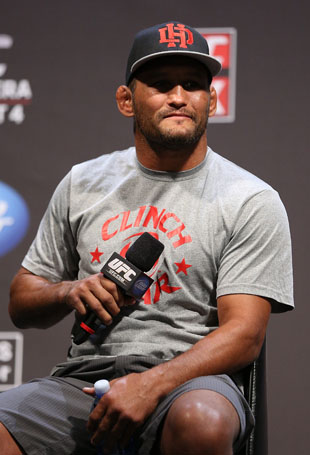
Dan Henderson?s camp not happy that his UFC 157 bout isn?t the main event

At UFC 157, Ronda Rousey's first defense of the women's bantamweight belt against Liz Carmouche is the main event. It's the only title fight on the card, and title fights getting main event status is a rule the UFC doesn't often break.

That didn't sit well with Dan Henderson's camp. He is fighting Lyoto Machida on the same card, and doesn't like being the second biggest name on the card. Gus Pugliese, Henderson's striking coach, told this to Gracie Magazine:

?Where I come from, there?s a pecking order for anything in life,? he said. ?I believe in paying dues. In this particular case, ?Hendo? and Machida paid their dues a long time ago. For someone new to come in and have a free ride just seems unfair to them and the whole sport they helped build.?

There's a legend about Chuck Berry and Jerry Lee Lewis from their time touring together during rock 'n' roll's infancy. A dispute arose over which man would close. Berry's camp won out, and he was given the last slot on the show. Lewis took his earlier spot, whipped the crowd into a frenzy with his performance and set his piano on fire during "Great Balls of Fire." He reportedly said to Berry, "Follow that!" as he left the stage.

While Henderson shouldn't literally set the octagon on fire like Lewis, the lesson from this possibly apocryphal story remains. If he wants to be the fighter everyone remembers from UFC 157, he can be. It doesn't matter if he is first, last, or somewhere in the middle of the card. Fans remember great fights. No one cares when they happened.

Source: http://sports.yahoo.com/blogs/mma-cagewriter/dan-henderson-camp-not-happy-ufc-157-bout-203722873--mma.html

Stevie J mothers day 2012 cinco de mayo osama bin laden death spinal muscular atrophy brooklyn nets may day protests

Wednesday, December 19, 2012

Hussain says Englands ruthless approach helped them clinch historic series win in India

Britain News.Net Tuesday 18th December, 2012

"The first Test in Ahmedabad may have seen England beaten heavily but the second innings there proved a turning point both in this series and in the future of this team. Without it things could look very different now," Hussain wrote in his column for the Daily Mail.

"But when Alastair Cook scored a big hundred in a losing cause in Ahmedabad in that second innings things changed," he added.

"It was the moment the captain said to his team: 'Hang on, there are no demons here. The ball is not spinning both ways. If we show some character, application and belief we can do this.' And since then the transformation has been astonishing," he further wrote.

Hussain added: "Everything England has done since then has been right. And their business has been conducted in a quite ruthless manner. There has been no dilly-dallying, no worrying about reputations. This has been anything but a closed shop."

"Tim Bresnan has been a very good cricketer for England but as soon as Cook and Andy Flower realised they had made a mistake in not picking Monty Panesar for the first Test the Yorkshireman was gone," he further wrote.

"Stuart Broad was England's vice-captain and one of the leading wicket-takers in world cricket in 2012 but when he had two poor Tests and England knew they had to get a fit-again Steven Finn in the side, Broad was also gone," he added

"England basically had to nail everything to win this series after going one down and they did it," he further said. (ANI)

Source: http://www.britainnews.net/index.php/sid/211445739/scat/fad6c6ce3bc72160

trayvon martin obama care miss universe canada don draper gallagher madmen james cameron

Tuesday, December 18, 2012

How human biology can prevent drug deaths

Thousands of people die from adverse effects of medicines that have been tested on animals. There is a better way, say geneticist Kathy Archibald and pharmacologist Robert Coleman

ADVERSE drug reactions are a major cause of death, killing 197,000 people annually in the European Union and upwards of 100,000 in the US. Little coverage is given to such grim statistics by governments or pharmaceutical companies, so patients and their doctors are not primed to be as vigilant as they should be, and adverse drug reactions (ADRs) remain seriously under-recognised and under-reported.

The ?5.88-million EU-ADR project, which published its final report in October, showed that it is possible to spot these reactions earlier by applying data-mining techniques to electronic health records. These techniques could, for example, have detected the cardiovascular risk signals of arthritis drug Vioxx three years before the drug was withdrawn in 2004 - saving many tens of thousands of lives. But invaluable as such systems are, it would be even better to detect risk signals before a drug reaches humans, thus saving even more lives.

Currently, 92 per cent of new drugs fail clinical trials, even though they have successfully passed animal tests. This is mostly because of toxicity, which can be serious and even fatal for the people taking part in the trials. For example, in 2006, six people enrolled in a UK trial of the drug TGN1412 were hospitalised after developing multiple organ failure. Many clinical trials are now conducted in India, where, according to India's Tribune newspaper, at least 1725 people died in drug trials between 2007 and 2011. Clearly, there is an urgent need for better methods to predict the safety of medicines for patients as well as volunteers in clinical trials.

At the patient safety charity, Safer Medicines, we believe this goal is most likely to be achieved through a greatly increased focus on human, rather than animal, biology in preclinical drugs tests. New tests based on human biology can predict many adverse reactions that animal tests fail to do, and could, for example, have detected the risk signals produced by Vioxx, which in animal studies appeared to be safe, and even beneficial to the heart.

These techniques include: human tissue created by reprogramming cells from people with the relevant disease (dubbed "patient in a dish"); "body on a chip" devices, where human tissue samples on a silicon chip are linked by a circulating blood substitute; many computer modelling approaches, such as virtual organs, virtual patients and virtual clinical trials; and microdosing studies, where tiny doses of drugs given to volunteers allow scientists to study their metabolism in humans, safely and with unsurpassed accuracy. Then there are the more humble but no less valuable studies in ethically donated "waste" tissue.

These innovations promise precious insights into the functioning of the integrated human system. Many are already commercially available, but they are not being embraced with the enthusiasm they merit.

Pharmaceutical companies would make much greater use of them if governments encouraged it, but inflexible requirements for animal tests is a major deterrent. Ever since the thalidomide birth-defects tragedy, animal testing has been enshrined in law worldwide, despite the irony that more animal testing would not have prevented the release of thalidomide, because the drug harms very few species.

So how well have animal tests protected us? Many studies have calculated the ability of animal tests to predict adverse reactions to be at or below 50 per cent. In 2008, a study in Theriogenology (vol 69, p 2) concluded: "On average, the extrapolated results from studies using tens of millions of animals fail to accurately predict human responses." And a recent study in Regulatory Toxicology and Pharmacology (vol 64, p 345) shows that animal tests missed 81 per cent of the serious side effects of 43 drugs that went on to harm patients.

It is hard to understand why governments defend a system with such a poor record, or why they are dismissive of new technologies that promise increased patient safety while decreasing the time and cost of drug development, not to mention the savings to healthcare systems from fewer adverse drug reactions. Proposals to compare human-based tests with animal-based approaches have been strongly supported by members of the UK parliament. The Early Day Motions they signed were among the most-signed of all parliamentary motions between 2005 and 2006, 2008 and 2009, and 2010 and 2012.

Safer Medicines has put these concerns to the UK Department of Health and the prime minister - to be told that "human biology-based tests are not better able to predict adverse drug reactions in humans than animal tests".

It is a tragedy that so many suffer or die through the use of inadequately tested drugs when tests based on human biology are readily available. Yet governments continue to mandate animal tests, despite the lack of a formal demonstration of fitness for purpose, and a growing global realisation among scientists that animal toxicity tests are inadequate and must be replaced.

In its 2007 report, Toxicity Testing in the 21st Century: A Vision and a Strategy, the US National Research Council called for the replacement of animal tests: "The vision for toxicity testing in the 21st century articulated here represents a paradigm shift from the use of experimental animals... toward the use of more efficient in vitro tests and computational techniques." To its credit, the US government is at least working on initiatives to hasten this. The UK government, however, still denies there is a problem. How many must die before it listens?

Kathy Archibald is director of the Safer Medicines Trust. She is a geneticist who worked in the pharmaceutical industry.

Robert Coleman is a pharmacologist with pharmaceutical industry experience. He is now a drug discovery consultant and adviser to the trust

If you would like to reuse any content from New Scientist, either in print or online, please contact the syndication department first for permission. New Scientist does not own rights to photos, but there are a variety of licensing options available for use of articles and graphics we own the copyright to.

Have your say

Only subscribers may leave comments on this article. Please log in.

Only personal subscribers may leave comments on this article

Subscribe now to comment.

All comments should respect the New Scientist House Rules. If you think a particular comment breaks these rules then please use the "Report" link in that comment to report it to us.

If you are having a technical problem posting a comment, please contact technical support.

Source: http://feeds.newscientist.com/c/749/f/10897/s/26ab6ed5/l/0L0Snewscientist0N0Carticle0Cmg21628950A0B20A0A0Ehow0Ehuman0Ebiology0Ecan0Eprevent0Edrug0Edeaths0Bhtml0Dcmpid0FRSS0QNSNS0Q20A120EGLOBAL0Qonline0Enews/story01.htm

Jerry Nelson Foo Canoodle Isaac path Tropical Storm Isaac path Hurricane Katrina Hurricane Isaac Path
Sunday, December 16, 2012

Get Kristen Stewart's Fully Rimmed Eyeliner Look

www.bellasugar.com:

Kristen Stewart has a tried-and-true formula for beauty: tousled hair, demure lipstick, and wow-factor eye makeup. She rarely strays from this combination because it works. At the On the Road premiere last night, she chose a fully rimmed eyeliner look with a winged finish, courtesy of celebrity makeup artist Beau Nelson.

Read the whole story at www.bellasugar.com

"; var coords = [-5, -72]; // display fb-bubble FloatingPrompt.embed(this, html, undefined, 'top', {fp_intersects:1, timeout_remove:2000,ignore_arrow: true, width:236, add_xy:coords, class_name: 'clear-overlay'}); });

Source: http://www.huffingtonpost.com/2012/12/15/kristen-stewart-eyeliner-bella-sugar_n_2308776.html

andrew lloyd webber obscura grok cirque du freak eric cantor eric cantor pope joan

Big price for inaugural pomp; much private money

WASHINGTON (AP) ? The pomp surrounding the inauguration of the president of the United States can carry a hefty price tag, from the glitzy galas to all those inaugural balls.

Think of it this way: It can cost about the same as 150 Bentley cars, several dozen yachts or some $20 million shy of the cash needed for a Boeing 737.

But taxpayers aren't on the hook for the fun stuff ? the balls and other celebratory events ? and this inauguration won't be as big as the last one for President Barack Obama.

A solid chunk of the tab for the 57th inauguration next month will be picked up by loyal supporters and other private donors, as it has been for years. In 2009, Obama raised $53 million in private money for his inauguration, when a record 1.8 million people braved the winter chill to see him take his place in history as America's first black president.

Previous inaugural committees have raised big cash, too, though not as much as Obama. President George W. Bush had about $40 million raised for each of his inaugurals. For President Bill Clinton, it was about $30 million in 1997.

But this time around, with the economy still sputtering out of the worst downturn since the Great Depression, Obama is scaling back the celebrations a bit.

The official activities will span three days, starting with a National Day of Service on Jan. 19 and culminating on Jan. 21 with the swearing-in, the parade and the balls. Last time, it was four days of events.

As for those inaugural balls, there won't be as many. There were 10 official balls four years ago, but this time around a source close to the inaugural planning says there will be fewer balls, though no final number has been decided yet.

In 2009, there also was a huge rock concert on the National Mall with U2, Bruce Springsteen, Beyonce and many others. No repeat this time. The planning for the 2013 inaugural doesn't include a mall concert.

Another big change is the way Obama will raise his inaugural funds.

Unlike four years ago, he now is accepting money from corporations to help pay for the festivities, and there are no limits on those donations. In 2009, the presidential inaugural committee capped individual donations at $50,000. Lobbyists and political action committees will still be banned from making donations.

Besides the balls and the traditional parade, private money also would pay for items such as giant TV screens on the mall for the swearing-in and thousands of portable toilets.

The other gigantic part of the tab is all the security. That's picked up by taxpayers, but it's harder to put a complete dollar figure on security. The Secret Service says it doesn't discuss those costs.

In 2009, the federal government reimbursed the District of Columbia $44 million for the inauguration. That was just for city costs, not Secret Service or military personnel.

The district's reimbursement included about $24 million paid to the Metropolitan Police Department, which hosted about 4,000 officers from surrounding jurisdictions. It also covered some $7 million for communications, call centers, fire and emergency medical services support costs. An additional $3 million was spent on repaving Pennsylvania Avenue for the parade, as well as for bus and traffic operations.

For this inaugural, some public money has already been set aside.

?The Architect of the Capitol has $4.2 million to spruce up the Capitol grounds for the swearing-in ceremony on the west front. That money also pays for the inaugural platform under construction, along with bleachers, and barricades.

?Nearly $2 million has been approved for U.S. Capitol Police.

?$1.2 million has been budgeted for the Joint Congressional Committee on Inaugural Ceremonies, which stages the day's activities on the Capitol grounds, including the traditional inaugural luncheon for the president and vice president. The menu at the luncheon four years ago featured seafood stew, duck, sour cherry chutney and apple cinnamon spongecake.

Not everything costs money, though.

Tickets are free for the swearing-in ceremony. People interested in attending should contact their senator or congressman to request a ticket. Viewing from the National Mall does not require tickets.

Hotel rooms, however, will cost folks, and some packages require a big fat wallet.

For $100,000, the Ritz-Carlton has an "Access Washington" package that includes two first-class round trip domestic airline tickets, a four-night stay in a luxury suite, private and behind-the-scenes tours of Washington landmarks, an inaugural parade watching party at the Newseum, a designer dress and fancy tuxedo, a diamond and ruby pin and more.

___

Online:

Inauguration committee: http://www.inaugural.senate.gov

Architect of the Capitol: http://aoc.gov/nations-stage/inauguration-us-capitol

Source: http://news.yahoo.com/big-price-inaugural-pomp-much-private-money-130842827.html

mega millions lottery jackpot winning numbers mega millions megamillions drawing olbermann mega millions march 30 lucky numbers

Friday, December 14, 2012

Biotech Startup Transcriptic Receives $1.2M In Seed Funding Led By Google Ventures And FF Angel

Transcriptic LogoStartup biotech company Transcriptic has raised $1.2 million in a seed funding round from a wide group of investors led by Google Ventures and FF Angel (Founders Fund's seed stage arm), and private investors Mark Cuban and Naval Ravikant. Notably, more than 60 accredited investors contributed $150,000 through a partnership between investment platforms AngelList and SecondMarket, which Transcriptic says makes it the first company to raise a significant equity round online.

Source: http://feedproxy.google.com/~r/Techcrunch/~3/zRgT-167sDQ/

golden globe nominees joe philbin miss america pageant 2012 shipwreck jose aldo vs chad mendes lana del rey john 3 16

Dolphin hearing system component found in insects

Dec. 13, 2012 ? A hearing system component thought to be unique in toothed whales like dolphins has been discovered in insects, following research involving the University of Strathclyde.

The research is challenging ideas about how a large group of insects including crickets and katydids hear, revealing the unexpected similarity to toothed whale hearing.

Scientists from the School of Biological Sciences at The University of Auckland, with colleagues from Plant & Food Research in New Zealand, led the research with engineers from the University of Strathclyde working on the biomechanical aspects of the project.

They discovered that the iconic New Zealand insect, the weta, rely on a unique lipid -- a compound that includes oils and fats -- to hear the world around them.

Dr James Windmill, of the University of Strathclyde's Centre for Ultrasonic Engineering, said: "As engineers we are particularly interested in how sound interacts with certain materials and how it travels to and from a source. These findings help us to improve our fundamental knowledge and could inspire new systems in ultrasound technologies like biomedical and non-destructive testing.

"The discovery is interesting as previously only toothed whales were known to use this hearing system component, the lipid. There are many similarities in the use of lipids to amplify the sounds and help both animal groups to hear.

"We don't know why animals who are so far apart in evolutionary terms have this similarity, but it opens up the possibility that others may use the same system component."

The sound is known to be transmitted through a liquid-filled cavity to reach the hearing organs, but until the current research was carried out it was presumed that the liquid was simply the insect equivalent of blood.

The researchers found that it was in fact a lipid of a new chemical class. They believe the role of the lipid is to efficiently transmit sound between compartments of the ear, and perhaps to help amplify quiet sounds.

Dr Kate Lomas from the University of Auckland, said: "In the weta, as in other members of the Ensiferan group which includes katydids and crickets, sound is detected by ear drums on the front legs."

Using new tissue analysis and three-dimensional imaging techniques the scientists also discovered a tiny organ in the insects' ears, which they named the olivarius after Dr Lomas' son Ollie. The organ appears to be responsible for producing the all-important lipid. It may have been overlooked in previous studies because standard analytical techniques, which are much harsher, would have damaged or destroyed the fragile tissue.

Dr Lomas added: "The ear is surprisingly delicate so we had to modify how we looked at its structure and in doing so we discovered this tiny organ."

The researchers carried out their work with the Auckland tree weta. They believe that the same method of hearing is likely to be used by other members of its biologic class, including crickets and katydids, which are famous for the sounds they produce.

Share this story on Facebook, Twitter, and Google:

Other social bookmarking and sharing tools:


Story Source:

The above story is reprinted from materials provided by University of Strathclyde.

Note: Materials may be edited for content and length. For further information, please contact the source cited above.


Journal Reference:

  1. Kathryn F. Lomas, David R. Greenwood, James FC. Windmill, Joseph C. Jackson, Jeremy Corfield, Stuart Parsons. Discovery of a Lipid Synthesising Organ in the Auditory System of an Insect. PLoS ONE, 2012; 7 (12): e51486 DOI: 10.1371/journal.pone.0051486

Note: If no author is given, the source is cited instead.

Disclaimer: Views expressed in this article do not necessarily reflect those of ScienceDaily or its staff.

Source: http://feeds.sciencedaily.com/~r/sciencedaily/top_news/top_environment/~3/1q40ZfvSSY8/121213084939.htm

real housewives of new jersey Kanye West sex tape emmys emmys torrey smith torrey smith oakland raiders